Go Service
Go Policies
Go About Us
Go View Cart
Go Checkout
Go Home
Shopping Cartimage GO
Search 
   Advanced Search GO
image
image
Empty
image

image

Categories
Beirut logos
Camp Lejeune logos
Camp Pendleton logos
Corpsman logo
FAST Company
GTMO
Helicopter logos
Hoods and crew neck sweat shirts
Infantry MOS
Kaneohe Bay, Hawaii
Marine Corps Schools
Marine Corps shirts
New
Okinawa logos
Operation Iraqi Freedom
Parris Island unit logos
Recon Logos
Reserve Units
Reunion Pictures
Sniper Hoods
Sniper logos
Support Units
T-shirt Clearance
Unit logos - Bulk Custom Samples
Yardguards
image
image

image

Are You Ready?
Just 290 days 'til Christmas!

image

Search Results

Found 7 product(s) for Recon Logos (1-7 of 7)

Recon Logos
1st Force Reconnaissance 1st Force Reconnaissance
The First Force Reconnaissance Company (commonly referred to as the 1st Force Recon) was the deep reconnaissance/direct action unit of the United States Marine Corps, that was assigned to the Fleet Marine Force, Pacific and its subordinate elements of the Marine Air-Ground Task Force. Most of the operators went to the newly created Marine Corps Forces Special Operations Command (MARSOC), to the 1st Marine Special Operation Battalion. Mission The company augmented active-duty forces or were mobilized to conduct pre-assault and deep post-assault reconnaissance and surveillance in support of Expeditionary Strike Group Three and I Marine Expeditionary Force and its subordinate elements; 11th, 13th and 15th Marine Expeditionary Units, the 1st Marine Expeditionary Brigade. [Organization In 1957, 1st Force Recon contained an amphib recon platoon, deep recon platoon, and a pathfinder platoon. By 1960, 1st Force Recon Company was located at Camp Del Mar (21 Area) and 13 Area of MCB Camp Pendleton and consisted of 6 reconnaissance platoons. One platoon rotated to Okinawa every 13 months to support the 3rd Marine Division and to provide pre-assault beach reconnaissance and post assault deep recon missions. The detached platoon was known as the Subordinate Unit #1, 1st (or 2nd, 3rd, etc.) Recon platoon. As of 2006, before its eve of deactivation, its company table of organization was registered at a full strength of six reconnaissance platoons; one headquarters and service platoon, two direct action platoons, two deep recon platoons, and one scout sniper platoon augmented from 1st Marine Division's Scout Sniper company. History First Force Reconnaissance Company was activated on June 19, 1957 at Camp Margarita (Area 33), Marine Corps Base Camp Pendleton, California. It was formed from the Reconnaissance Platoon of Marine Corps Test Unit #1 that was assigned to take over the guideon of 1st Amphibious Reconnaissance Company, that was under command of Captain "Cycle" Michael Sparks. Many Marines from the amphib recon company and 1st Reconnaissance Battalion augmented the new Fleet Marine Force-level reconnaissance capabilities to force commanders. The Company's first company commander was Major Bruce F. Meyers, with Captain Joseph Z. Taylor as his executive officer. Meyers was MCTU#1's project test officer that led the development and refinement of submarine insertions/extractions techniques, low level static line and military free fall parachute insertion, the closed-circuit SCUBA procedures and capabilities developed the initial deep reconnaissance capability within the Department of Defense. By 1958, approximately half of the 1st Force Reconnaissance Company was reassigned and transferred to Marine Corps Base Camp Lejeune, North Carolina to form the 2nd Force Reconnaissance Company; under command of Joseph Z. Taylor, promoted to Major. On October 26, 2006, 1st Force Reconnaissance followed the same footsteps as the 2nd Force Recon Company, also too becoming deactivated. The remaining force recon Marines either integrated into the Deep Recon Platoons (DRP) of 1st and 3rd Division Recon Battalions, or folded into 1st Marine Special Operations Battalion (1st MSOB) of the Marine Special Operations Command (MARSOC). Post-Korean War 1st Platoon, Sub Unit #1, embarked onto the USS Epping Forest and sailed for southern Thailand, to the Royal Thai Navy base of Sattahip, in December 1964. The 1st Platoon conducted reconnaissance patrols with the Royal Thai Marine Corps, with one Thai Marine attached to each of the 4-man force recon teams. By May, they finished their recon operations in Thailand and sailed for Vietnam for the planned amphibious landings in March 1965. Vietnam War Prior to the first of many Marine amphibious landings made by the 9th Marine Expeditionary Brigade throughout March 1965, 1st Platoon, Sub Unit #1, 1st Force Reconnaissance Company (-), conducted preliminary reconnaissance of the planned amphibious beach landings. The sub unit was the first Force Recon unit to serve in Republic of Vietnam and was lead by Captain David Whittingham. Their first mission was to reconnoiter the area around Cam Ranh Bay for its selection as major port for the U.S forces in south Vietnam, they also carried out reconnaissance and survey of the beaches around Da Nang prior to the Marine Battalion landing. By early May 1965, the 2nd Platoon had joined 1st Platoon with the Subordinate Unit #1 and its both platoons were assigned to the United States Special Forces A-Team, A-103, conducting specialized reconnaissance and combat raiding missions. They operated from Da Nang, Phu Bai, Chu Lai, Gia Vuc and Kham Duc, in the I Corps Tactical Zone (ICTZ). Their mission were to collect any enemy intelligence in the mountain approaches to the Marines' tactical area of operation along the Laos border, and to report any findings directly to the general staff of the III Marine Amphibious Force. November 1965, 2nd Platoon was attached to the Special Forces team A-106 at Ba To. A combine patrol from Ba To was attacked on the night of the 16 December, three Marines a Green Beret Sergeant and 10 members of the Civilian Irregular Defense Group (CIDG) were killed. By mid-December 1965, 3rd platoon arrived to the Republic of Vietnam and was attached to Special Forces team A-107 at Tra Bong. The rest of the Force Recon Company (its remaining two platoons, 4th and 5th Plt.) arrived in June 1965.
[24 in stock]
Price: $18.00
More details More details
 
1st Recon Battalion 1st Recon Battalion
1st Reconnaissance Battalion (1st Recon Bn) is a reconnaissance battalion in the United States Marine Corps. It falls under the command of the 1st Marine Division and the I Marine Expeditionary Force (I MEF). 1st Recon Battalion was reactivated on July 5, 2000 as part of Marine Corps Commandant General James L. Jones’ mission to revitalize Marine Corps reconnaissance. Their scope of missions is broad and currently changing due to Force Reconnaissance units making the move to Marine Corps Special Operations Command. Organization 1st Reconnaissance Battalion currently consists of four Reconnaissance companies: a Headquarters and Service Company, Alpha, Bravo, Charlie, and Force Reconnaissance Company. While the Force Reconnaissance Company is an organic element of the battalion, Operational Control of the company resides with the I MEF commander. Cuban Missile Crisis 1st Reconnaissance Battalion (Forward) deployed to Guantanamo Bay, Cuba and Haiti in October-November 1962 to await the invasion of Cuba. Upon the resolution of the Cuban Missile Crisis, the battalion returned to MCB Camp Pendleton. Vietnam War Persian Gulf In 1990—1991, the battalion participated in Operation Desert Shield/Desert Storm. 1st Reconnaissance Battalion was redesignated as 1st Reconnaissance Battalion (Light Armored) with all assets turned over in June 1992. Recon Marines with less than 2 years left in service formed the 5th Marine Regiment/5th Marines Recon Co. 1st Recon Company, which was then overstaffed and redesignated 1st Recon Battalion again in 2000, with only 50 unfilled billets on its first day. Global War on Terror In January 2006, the battalion was in the national news for leading Operation Green Trident, which discovered over ten metric tons of insurgent munitions, hidden in caches throughout a large area south of Fallujah in the Euphrates River Valley. Marines of 1st Recon have told military reporters that about 90% of their time in Operation Iraqi Freedom has been spent in mounted patrols, using their Humvees.
[14 in stock]
Price: $18.00
More details More details
 
2nd Force Reconnaissance 2nd Force Reconnaissance
The Second Force Reconnaissance Company was the deep reconnaissance/direct action that was assigned to the Fleet Marine Force, Atlantic and its subordinate elements of the Marine Air-Ground Task Force. Mission The company augmented active-duty forces or were mobilized to conduct pre-assault and deep post-assault reconnaissance and surveillance in support of Expeditionary Strike Group Two and II Marine Expeditionary Force and its subordinate elements; 22nd, 24th and 26th Marine Expeditionary Units, the 2nd Marine Expeditionary Brigade. Organization In 1958, the 2nd FORECON contained a headquarters and service platoon, pathfinder platoon, amphib recon platoon, and a deep recon platoon. As of 2006, before its eve of deactivation, its company table of organization was registered at a full strength of six reconnaissance platoons; one headquarters and service platoon, two direct action platoons, two deep recon platoons, and one scout sniper platoon augmented from 2nd Marine Division's Scout Sniper company. History 2nd Force Recon Company seal during the late 1950s. 2nd Force Recon Company was formed when the executive officer of 1st Force Recon, Captain Joseph Z. Taylor, took half of the Marines from 1st FORECON and brought them to the east coast to the 2nd Amphibious Reconnaissance Company, located on Marine Corps Base Camp Lejeune, North Carolina. In February 2006, 2nd Force recon Company disbanded. The most experienced operators were selected for the 2nd Marine Special Operations Battalion (2nd MSOB); others either filled the ranks of the 2nd Reconnaissance Battalion under the 2nd Marine Division, forming the Direct Action Platoons (DAP) and the Deep Recon Platoons (DRP). The DAPs and DRPs are established to maintain the direct action/deep recon support to the MAGTFs, for MEF and MEU(SOC) commanders.
[24 in stock]
Price: $18.00
More details More details
 
2nd Marine Special Operations Battalion 2nd Marine Special Operations Battalion
MSOB tasks include direct action, special reconnaissance, counter-terrorism, and information operations. Each MSOB consists of four Marine Special Operations Companies (MSOCs) that contain eight Teams in each Company. The organization allows a Team to operate on its own if needed, but maintains the ability to operate as part of a bigger unit such as an MSOC or SOTF, similar to Army Special Forces ODA/B. The core personnel strength of the MSOBs was initially drafted from Force Reconnaissance Marines.
[0 in stock]
Price: $0.00
More details More details
 
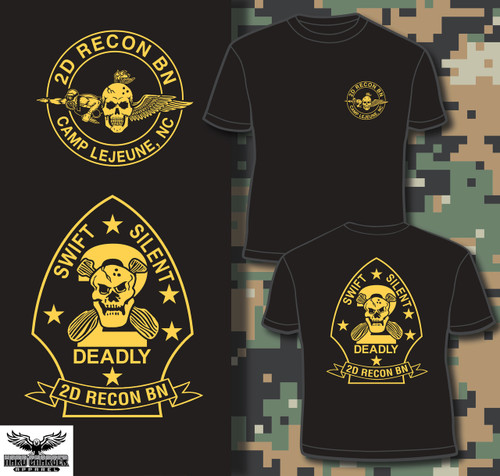
2nd Recon Battalion 2nd Recon Battalion
The 2nd Reconnaissance Battalion (2nd Recon) is a reconnaissance battalion in the United States Marine Corps. Located at Marine Corps Base Camp Lejeune, North Carolina the battalion falls under the command of the 2nd Marine Division and the II Marine Expeditionary Force (II MEF). 2nd Recon is a battalion of men trained/specializing in reconnaissance and surveillance. The men of this battalion are also trained in close quarters battle (CQB) tactics and other special missions. Recon Marines are sent to various schools to learn various special skills including but not limited to: Scout Sniper school, Jump school, Military Free Fall school, Combatant Dive school, Ranger school, various civilian run schools (i.e. McMillian sniper school), and other Department of Defense (DOD) and Special Operations Command (SOCOM) sponsored schools. History Tarawa, November 1943 Main article: Battle of Tarawa Prior to D-Day of November 10, no prior preliminary pre-D-Day reconnaissance was performed prior to their landing except the submarine periscope photography performed by Capt. James Jones, of VAC Amphib Recon Company aboard the USS Nautilus. The Marine recon units of 2nd Marine Division participated in seizure and occupation of Tarawa operation. A Scout-Sniper Platoon of 2nd Marine Regiment led by 1st Lieutenant William D. Hawkins were the first unit to land on Betio in the Tarawa Atoll, the site of a strategically important airfield. He was tasked in securing the island ramp on one of the two long piers extending into the lagoon. Hawkins and his recon-scout platoon raced ahead of the first wave in two Higgins Boats and landed on the pier. He charged up the ramp with his scouts but were taken under heavy machine gun fire. Since there were petrol drums at the end of the pier were in the line of enemy fire, he sent most of his Marines back down the ramp then proceeded with only five men, four scouts and one combat engineer with a flamethrower. Once they burned and had blown up every hiding place left on the pier, they withdrew to the boat. Hawkins then commandeered three LVTs and transferred his men from both LCVPs to these for the trip to shore where they joined their regiment for the rest of the battle.[1] Lt. Hawkins was later killed during this action and was posthumously received the Medal of Honor.[2] Another Scout-Sniper Platoon from 8th Marines assisted in the main assault landing on D-Day. The Company D (Scouts), 2nd Tank Battalion worked extensively in the seizure and occupation of other islands in the Tarawa Atoll. Other than Betio, it included Eita and many unnamed islets between Betio and Bairiki. The adjacent atolls of Abaiang, Marakei and Maiana were landed for inspection of fortifications, supplies or recent occupancy. Another separate mission, a Scout-Sniper Platoon of 2nd Marine Regiment led by 1st Lieutenant William D. Hawkins were the first unit to land on Betio in the Tarawa Atoll, the site of a strategically important airfield. Saipan, June 1944 The 2nd Marine Division's scout company performed a series of special missions with 4th Marine Division's scout company, that included a recon detachment with 1st Battalion, 9th Marine Regiment (1/9). Seizing the summit of Mount Tapochau later repulsed a Japanese counterattack on that highest point of Saipan.[2] Both Admiral Richmond K. Turner and General Holland M. Smith declared Saipan secured on July 9, 1944.
[32 in stock]
Price: $18.00
More details More details
 
3rd Recon Battalion 3rd Recon Battalion
The 3rd Reconnaissance Battalion conducts amphibious and ground reconnaissance for the 3rd Marine Division and Marine Forces, Pacific (MarForPac), operating in the commander's areas of influence. Company B is responsible for providing deep reconnaissance and direct action assets to the III Marine Expeditionary Force and Fleet Marine Force, Pacific (FMFLant). They support the only Marine Air-Ground Task Force that exists within the III MEF, the 31st Marine Expeditionary Unit (31st MEU). The 3rd Recon Battalion is based out of Camp Schwab, a satellite base of Marine Corps Base Camp Smedley D. Butler. It is geographically located on the Okinawa Prefecture in Japan. Organization The 3rd Recon Battalion consists of approximately 200 Marines and Sailors that falls under the command of the III Marine Expeditionary Force. Company B was formed from the 5th Force Reconnaissance Company due to the formation of the Marine Special Operations Teams (MSOT) in 2006. 3rd Recon Battalion supports the 31st Marine Expeditionary Unit by augmenting a Reconnaissance and Surveillance (R&S) Platoon. Vietnam War Between 10—April 14, 1965, two battalion landing teams (BLT) of 3rd Marine Regiment landed on the beaches of Da Nang in Vietnam unopposed, 2nd and 3rd Battalion from the 9th Marine Expeditionary Brigade. They were the first US military force that landed during the Vietnam War. Their objectives were to secure an airfield at Phu Bai and establish an affective beachhead.[4] The Marines made their first firefight encounter on 22 April 1965 against a small company of Viet Cong. A patrol of men from Company D of 3rd Recon were scouting 13-kilometers southwest of Da Nang, accompanied by a few platoons of soldiers from the Army of the Republic of Vietnam (ARVN). After a brief intense exchange of small arms fire, outnumbered, the recon Marines radioed in for support. A infantry company from Battalion Landing Team 1st Battalion, 3rd Marines (BLT 1/3) reinforced the small group of Company D and the ARVN. The combined force were able to were able to push the hostile force back several kilometers before losing them in the heavy foliaged terrain.[4] Two days later on 14 April, a recon squad positioned 2-km south of Phu Bai were under a surprise attack by a small skirmish of VC as the Marines were setting up defensive positions for the night. Although the firefight lasted only for a few minutes, both sides resulted in casualties; each side lost two men.[4] Late in the afternoon on May 7, 1965, elements of 3rd Recon Battalion arrived to Chu Lai from Da Nang and secured the beachhead's southern flank as BLT 1/4 were setting up several kilometers inland. A few days later, BLT 3/3 arrived from Okinawa; 3rd Recon Battalion returned to Da Nang.[4] On July 12, 1965, an eighteen-man patrol from Company A was under fire approximately 20-kilometers southwest of the Da Nang Air Base. 1st Lieutenant Frank S. Reasoner, the patrol leader, and his patrol were under a barrage of heavy fire. His radio operator was hit by enemy fire and Reasoner came to his aid as he provided cover, killing two VC and interrupting hostile automatic weapons fire. As he were about to render hasty first aid to his radioman, he received a mortal wound. Frank Reasoner became the first Marine to earned the Medal of Honor in South Vietnam. January 1, 1969, A recon platoon inserted in four helicopters near the Laotian border west of Khe Sahn during Operation Dawson River (West). The reconned landing zones for the 9th Marine Expeditionary Brigade's infantry battalions. The clandestine reconnaissance provided the rifle platoons to land safely with the need for a prelanding artillery or aerial bombardment, giving the unannounced arrival an advantage from any lurking VC or North Vietnamese Army (NVA) forces. Interim Years, 1975—present In March 2004, elements of Company B deploy to the Persian Gulf in support of Operation Iraqi Freedom. On 13 February 2005, 3rd Reconnaissance Battalion deployed to Iraq to conduct combat operations in the Al Anbar Province, and was the focus of the documentary film Alpha Company: Iraq Diary. On 29 September 2006, 3rd Reconnaissance Battalion again deployed to Iraq to conduct combat operations in the Al Anbar Province. On 15 April 2008, 3rd Reconnaissance Battalion deployed again to Iraq to conduct combat operations in Al Anbar Province for its' third combat tour.
[17 in stock]
Price: $18.00
More details More details
 
Amphibious Reconnaissance School Amphibious Reconnaissance School
[34 in stock]
Price: $18.00
More details More details